UX Design Framework
The design thinking framework is a user-centered problem-solving technique that incorporates activities such as research, prototyping, and testing to help you understand who your user is, what their problems are, and what your design should include.
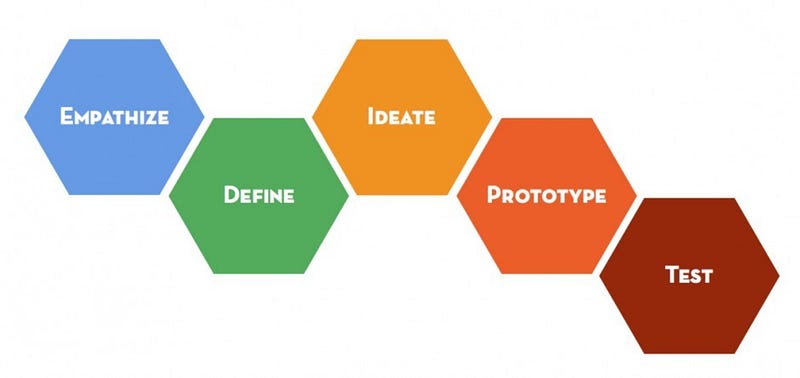
Empathize, define, ideate, prototype, and test are the phases of the design thinking framework.
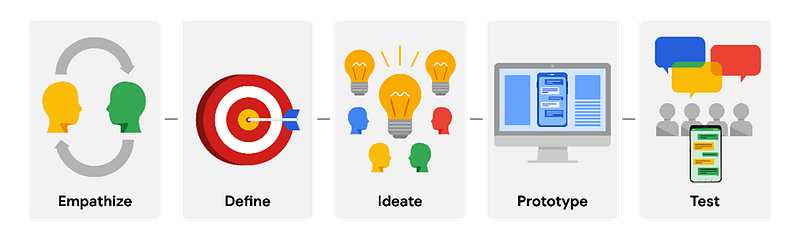
Though it may appear to be a linear process, the design thinking framework should be iterative, which means you'll repeat some phases as you enhance your designs. For example, based on the feedback you obtain during testing, you may need to undertake extra research, generate new ideas, or create new prototypes.
Let's take a look at the five phases of the design thinking framework to see what tasks you'll do during each one. Keep in mind that the design thinking framework described here is an idealized model for UX designers to follow, thus its implementation may differ between businesses, teams, or projects.
Empathize
The major purpose of the empathize phase is to understand more about the user and their issues, goals, and needs, as well as the setting or context in which they will experience your design. The most crucial aspect of the empathize phase is to pull back from your preconceptions and predictions and allow your research findings to drive your decision-making in subsequent design phases.
User surveys, interviews, and observation sessions may be part of your user research, and you may also need to undertake some study on competitors' products to determine how your user frames competitors' products as part of their everyday life and daily problem-solving.
Define
In the define phase, you will analyze your empathize phase research findings to identify which user problems are the most critical to fix and why. This will direct you towards a clear aim for the product's design.
This phase's most significant consequence is a clear issue statement, which is a description of the user's requirement that your designs will answer.
You might also create a value proposition, which is a summary of why your target audience would or should use the product or service you're building.
Ideate
The ideate phase begins when you've identified a user problem and determined why it's necessary to address. The purpose of ideation is to generate as many design solutions as possible; don't settle for the obvious solution because it isn't always the best one.
Ideation entails brainstorming with other members of your team in order to develop as many solutions as feasible. Marketing, engineering, product management, and any other stakeholders for the product or service could be included. You should consider all conceivable solutions during brainstorming sessions. Don't worry about if something is a "good" or "bad" idea; just gather as many as you can. The key here is to maintain this procedure devoid of judgement.
After brainstorming, you'll analyze your prospective solutions and begin to make decisions about which ones to pursue as prototypes. Return to user or competitive research to assist you narrow down your ideas, and develop user flows to show how the user will interact with your solution.
Prototype and Test
You're ready to join the prototype phase once you've figured out how to address the problem. Your goal is to create an early model of a product that illustrates its functionality and can be used for testing. The test phase is crucial to developing the proper answer to your user's problem, and an organized testing approach will help you produce excellent user experiences.
Because prototyping and testing are intertwined, you'll test your designs at each stage of prototype development rather than waiting until the working prototype is finished. If you show the design to users too polished the first time, you may not receive as much feedback. Consider strategies to incorporate testing throughout the design process so that you can iterate your designs based on user feedback rather than other factors.
The purpose of testing prototypes is to continue to refine the prototype as you get input into whether your product or service's design is simple to use and answers the user's problem. You'll eventually finish a prototype and hand it over to developers, who will convert your idea into a product.